
How AI Is Transforming the FMCG Industry in 2026
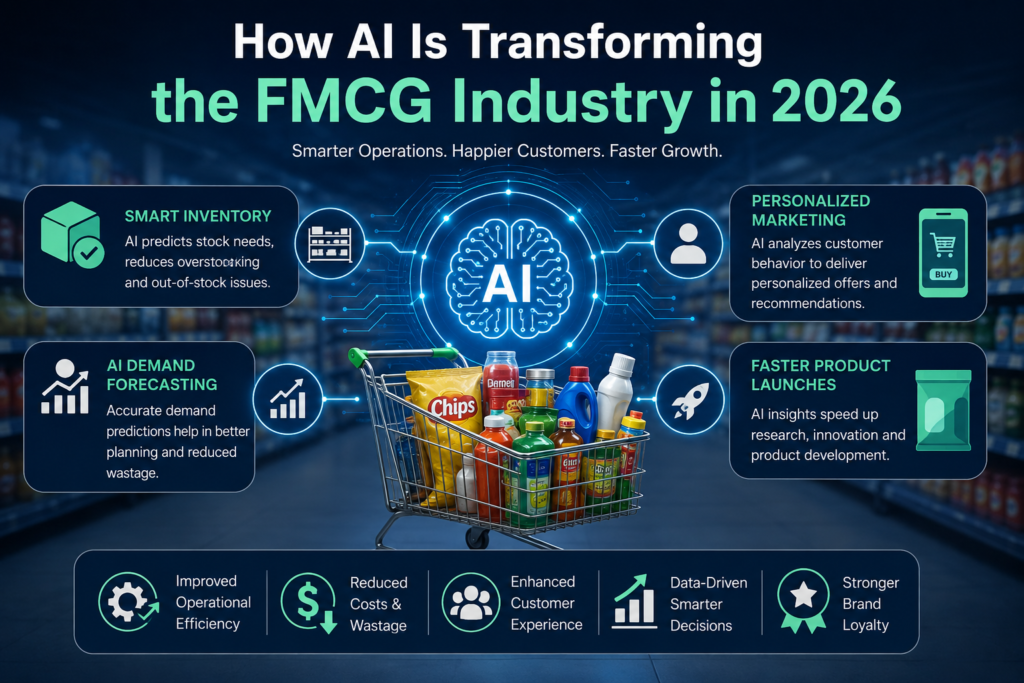
The FMCG industry is evolving faster than ever, and Artificial Intelligence (AI) is becoming the driving force behind this transformation. From predicting customer demand to creating personalized shopping experiences, AI is helping FMCG brands become smarter, faster, and more efficient in 2026.
Today, leading brands are no longer relying only on traditional marketing and manual operations. Instead, they are using AI-powered technologies to improve supply chains, understand consumer behavior, reduce waste, and launch products faster than ever before.
In this blog, we’ll explore how AI is revolutionizing the FMCG industry and why businesses that adopt AI early will stay ahead of the competition.
What Is AI in FMCG?
Artificial Intelligence in FMCG refers to the use of smart technologies and machine learning systems to automate processes, analyze customer data, and make better business decisions.
AI helps FMCG companies:
- Predict customer demand
- Optimize inventory management
- Personalize marketing campaigns
- Improve customer service
- Speed up product development
- Increase operational efficiency
As consumer expectations continue to rise, AI is becoming essential for modern FMCG growth.
1. Smart Inventory Management
One of the biggest challenges for FMCG brands is maintaining the right inventory levels. Overstocking leads to waste, while understocking causes product shortages and lost sales.
AI-powered inventory systems can analyze:
- Past sales data
- Seasonal trends
- Consumer buying patterns
- Weather conditions
- Market demand
This helps companies maintain optimal stock levels and reduce inventory losses.
Benefits of Smart Inventory:
✔ Reduced product wastage
✔ Better warehouse management
✔ Faster stock replenishment
✔ Lower operational costs
✔ Improved customer satisfaction
In 2026, many FMCG companies are using real-time AI systems to automate inventory decisions and improve supply chain efficiency.
2. AI Demand Forecasting
Demand forecasting is becoming more accurate with AI.
Traditional forecasting methods often fail because consumer behavior changes rapidly. AI can process huge amounts of data instantly and identify patterns humans may miss.
AI forecasting tools analyze:
- Online shopping trends
- Social media behavior
- Festival seasons
- Local demand variations
- Economic conditions
This allows FMCG brands to predict future demand with higher accuracy.
Why AI Forecasting Matters:
- Prevents stock shortages
- Improves production planning
- Reduces unnecessary manufacturing
- Helps businesses respond quickly to trends
For example, if a health drink suddenly becomes popular on social media, AI systems can detect the trend early and help brands increase production before demand peaks.
3. Personalized Marketing & Customer Experience
Modern consumers expect personalized experiences, and AI is making this possible for FMCG brands.
AI tools can analyze customer behavior and create targeted marketing campaigns based on:
- Purchase history
- Search behavior
- Product preferences
- Demographics
- Online engagement
This helps brands deliver:
- Personalized ads
- Product recommendations
- Customized offers
- Smart email campaigns
Example:
If a customer frequently buys organic products, AI can recommend similar healthy or eco-friendly items automatically.
Personalized marketing improves:
✔ Customer engagement
✔ Brand loyalty
✔ Conversion rates
✔ Return on investment (ROI)
In 2026, hyper-personalization is becoming one of the strongest marketing strategies in the FMCG sector.
4. Faster Product Development & Launches
AI is helping FMCG companies launch products faster by reducing research and testing time.
Using AI analytics, brands can identify:
- Consumer preferences
- Trending flavors
- Packaging choices
- Market gaps
- Competitor strategies
AI-powered systems can even predict which products are likely to succeed before launch.
Advantages:
- Faster innovation cycles
- Reduced research costs
- Better product-market fit
- Higher success rates
For example, AI can analyze customer reviews and social media comments to discover what consumers want in a new beverage, snack, or skincare product.
This allows companies to develop products based on real consumer insights instead of guesswork.
5. AI-Powered Supply Chain Optimization
Supply chain disruptions can cause major losses for FMCG businesses. AI is helping companies create smarter and more resilient supply chains.
AI systems can:
- Track shipments in real time
- Predict delivery delays
- Optimize transportation routes
- Reduce fuel costs
- Improve logistics planning
This leads to:
✔ Faster deliveries
✔ Lower transportation expenses
✔ Better retailer relationships
✔ Improved operational efficiency
AI-driven supply chains are becoming a major competitive advantage in 2026.
6. AI in Retail & Customer Shopping
Retail experiences are also changing rapidly due to AI.
Modern FMCG retailers are using:
- Smart shelves
- AI-powered recommendations
- Automated checkout systems
- Voice shopping assistants
- Predictive shopping technology
AI helps stores understand which products customers interact with the most and optimize product placement accordingly.
This creates a more convenient and engaging shopping experience.
7. AI-Generated Content & Advertising
Marketing teams are increasingly using Generative AI tools to create:
- Social media posts
- Product descriptions
- Ad copy
- Video scripts
- Creative campaign ideas
This helps FMCG brands:
- Save time
- Reduce creative costs
- Produce content faster
- Scale marketing campaigns easily
AI tools also analyze campaign performance and optimize ads for better engagement.
Challenges of AI in FMCG
Although AI offers many advantages, there are still some challenges:
Data Privacy
Brands must protect customer data and maintain transparency.
High Initial Investment
Advanced AI systems may require significant setup costs.
Skilled Workforce
Companies need trained professionals to manage AI technologies effectively.
Technology Integration
Integrating AI into existing systems can be complex.
Despite these challenges, the long-term benefits of AI are much greater for most FMCG businesses.
The Future of AI in FMCG
The future of FMCG will become increasingly data-driven and automated.
In the coming years, we can expect:
- More AI-powered shopping experiences
- Advanced customer personalization
- Smarter product recommendations
- Fully automated supply chains
- Faster innovation cycles
- Sustainable production optimization
Brands that adapt to AI early will gain a major advantage in the competitive FMCG market.
Conclusion
Artificial Intelligence is no longer just a future concept — it is already transforming the FMCG industry in 2026.
From smart inventory systems and demand forecasting to personalized marketing and faster product launches, AI is helping brands improve efficiency, reduce costs, and deliver better customer experiences.
As technology continues to evolve, AI will become one of the most powerful growth tools for FMCG businesses worldwide.
Companies that embrace AI today are preparing themselves for the future of smarter, faster, and more customer-focused business operations.