
Future of FMCG Brands: AI, Automation & Zero Human Marketing (2026–2030)
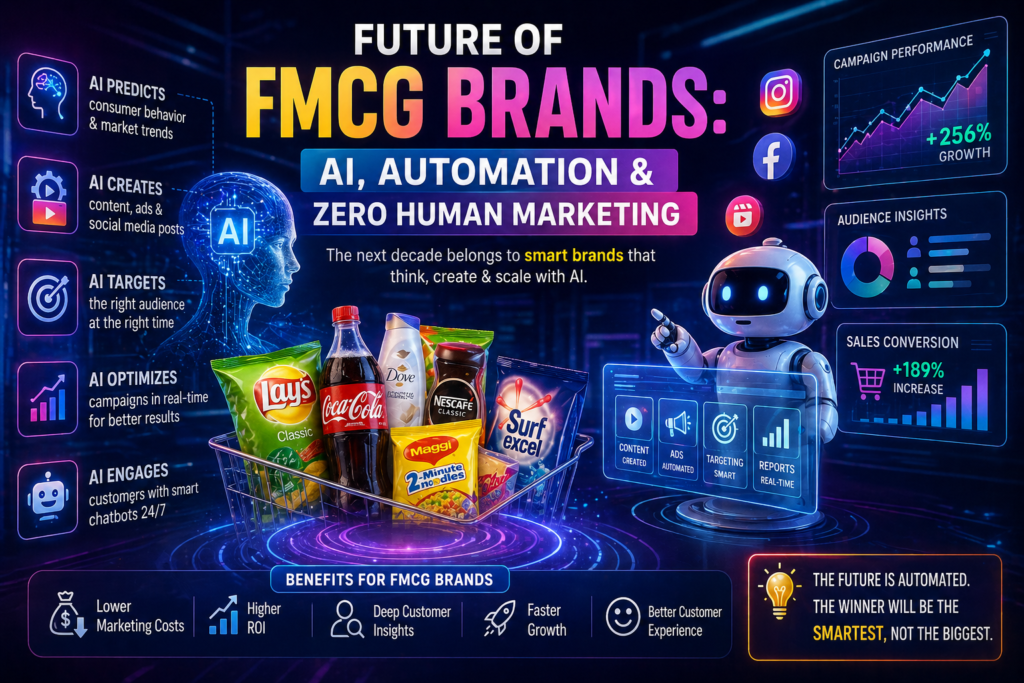
🚀 Introduction
The FMCG industry is entering a new era — one driven not by human decisions, but by data, algorithms, and automation.
For decades, FMCG brands relied on traditional marketing strategies like television advertising, retail promotions, and large-scale distribution networks. But today, rapid advancements in Artificial Intelligence (AI) are transforming how brands connect with consumers.
From predicting what customers will buy next to automatically generating viral social media content, AI is reshaping the entire marketing ecosystem.
👉 The big question is:
Are we moving toward a future where marketing runs without humans?
Let’s explore how AI, automation, and the concept of Zero Human Marketing are redefining FMCG brands between 2026 and 2030.
🧠 What is Zero Human Marketing?
Zero Human Marketing refers to a system where AI handles nearly all marketing activities with minimal human involvement.
This includes:
- Content creation (ads, videos, captions)
- Audience targeting
- Campaign management
- Performance optimization
- Customer engagement
In this model, humans shift from execution roles to strategic oversight, while AI handles the heavy lifting.
👉 Think of it as “marketing on autopilot.”
⚙️ The Evolution of FMCG Marketing
To understand the future, it’s important to see how far FMCG marketing has come:
📺 Traditional Era
- TV ads, newspapers, billboards
- Mass marketing approach
- Limited audience insights
📱 Digital Era
- Social media marketing
- Influencer collaborations
- Performance tracking
🤖 AI Era (Current & Future)
- Predictive analytics
- Automated campaigns
- Hyper-personalized experiences
👉 The shift is clear:
From mass marketing → to personalized → to autonomous marketing
🤖 Key Roles of AI in FMCG Brands
AI is not just a tool — it’s becoming the core engine of FMCG marketing.
1. 📊 Predictive Consumer Behavior
AI analyzes massive datasets including:
- Purchase history
- Browsing patterns
- Social media activity
This allows brands to:
- Predict demand
- Forecast trends
- Launch products at the right time
👉 Example: A snack brand can predict which flavor will trend next season.
2. 🎥 AI-Powered Content Creation
AI tools can now:
- Generate Instagram Reels
- Create product visuals
- Write captions and ad copy
This reduces:
- Time
- Cost
- Dependency on creative agencies
👉 Result: Faster content production with consistent quality.
3. 🎯 Hyper-Personalized Marketing
Instead of showing the same ad to everyone, AI enables:
- Individual-level targeting
- Personalized product recommendations
- Dynamic ad creatives
👉 Every consumer sees content tailored to their preferences.
4. ⚡ Real-Time Campaign Optimization
AI continuously monitors campaign performance and:
- Adjusts targeting
- Optimizes budgets
- Improves creatives
👉 Campaigns become smarter over time without manual intervention.
5. 💬 AI-Driven Customer Engagement
AI chatbots and virtual assistants can:
- Answer queries instantly
- Suggest products
- Handle complaints
👉 This ensures 24/7 customer support and improves user experience.
⚡ Marketing Automation in FMCG
Automation takes AI capabilities and turns them into fully functional systems.
What can be automated?
- Social media posting
- Email marketing campaigns
- Ad retargeting
- Customer segmentation
- Sales funnels
👉 Once set up, these systems run continuously with minimal supervision.
🧠 Can Marketing Become Fully Automated?
This is where reality meets hype.
✅ What AI Can Fully Handle:
- Data analysis
- Campaign optimization
- Content generation
- Audience targeting
❌ What Still Needs Humans:
- Brand storytelling
- Emotional connection
- Cultural understanding
- Creative direction
👉 Marketing is not just data — it’s also emotion.
Even the most advanced AI still struggles with human nuance and storytelling depth.
📈 Benefits of AI & Automation in FMCG
🚀 1. Speed & Efficiency
AI executes tasks in seconds that used to take days.
💸 2. Cost Reduction
Less dependency on large teams and agencies.
🎯 3. Better Targeting
Highly accurate audience segmentation.
📊 4. Data-Driven Decisions
No guesswork — only insights.
🔄 5. Scalability
Campaigns can be scaled instantly across regions.
⚠️ Challenges & Risks
Despite its advantages, AI-driven marketing has limitations:
1. Lack of Human Touch
Over-automation can make brands feel robotic.
2. Data Privacy Issues
Handling user data responsibly is critical.
3. Overdependence on Technology
System failures can disrupt operations.
4. Creative Limitations
AI often replicates patterns rather than creating originality.
👉 The key is balance — not blind adoption.
🔮 Future Trends (2026–2030)
🤖 1. Fully Autonomous FMCG Brands
Brands run almost entirely by AI systems.
🎭 2. AI Influencers
Virtual personalities promoting products.
🛒 3. Predictive Commerce
Consumers are shown products before they search.
📱 4. Real-Time Personalization
Every user sees unique content instantly.
🧾 5. Voice & AI Assistants Shopping
Consumers order FMCG products via voice AI.
⚖️ The Rise of Hybrid Marketing
Despite automation, the future is not AI alone.
👉 The winning strategy is Hybrid Marketing:
- AI handles execution
- Humans handle strategy and creativity
Example:
- AI runs ads
- Humans define brand voice
👉 This combination ensures both efficiency and emotional connection
🏁 Conclusion
The FMCG industry is on the edge of a major transformation.
AI and automation are not replacing marketers — they are redefining their roles.
👉 The future is not “zero humans”
👉 It’s smarter humans with powerful AI tools
💡 Final Insight:
Brands that:
- Adopt AI early
- Balance automation with creativity
- Focus on customer experience
👉 Will dominate the FMCG market in the coming decade.