
By Dhruv Kubadia | FMCG Consultant | 26 March 2026 | 12 min read
One of the first – and most consequential – decisions a new FMCG brand founder must make has nothing to do with the product formula, the packaging, or even the price. It is this: How does my product actually get to the consumer?
Pick the wrong distribution channel and you will spend your working capital fighting battles your brand isn’t ready to fight. Pick the right one and your product can reach millions of households in a matter of months.
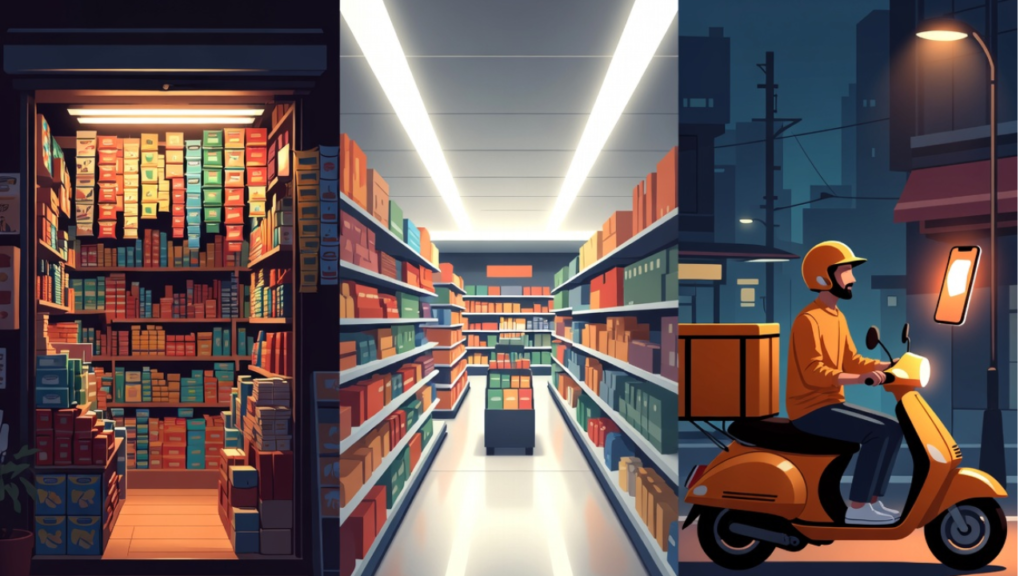
In India, there are three primary distribution channels available to FMCG brands in 2026: General Trade (GT), Modern Trade (MT), and the newest and fastest-growing force – Quick Commerce (Q-Commerce). Each of these channels has its own economics, requirements, advantages, and limitations.
In this guide, I’ll walk you through each channel in detail, compare their margin structures, and give you a clear decision framework to figure out which one – or which combination – is right for your brand at your current stage.
What You’ll Learn
- India’s FMCG Distribution Landscape in 2026
- Deep Dive: General Trade (GT)
- Deep Dive: Modern Trade (MT)
- Deep Dive: Quick Commerce
- Channel Comparison: Margins, Reach & Complexity
- The Decision Matrix: Which Channel for Your Brand?
- The Smart Play: Going Hybrid
- Final Verdict + My Recommendations
India’s FMCG Distribution Reality in 2026
Before diving into each channel, it helps to understand the macro picture. India’s FMCG market is projected to exceed $220 billion in 2026, growing at 14–15% annually. But that growth is not distributed equally across channels.
Here is how the current channel split looks for a large FMCG company like Hindustan Unilever – widely considered the benchmark for Indian distribution: around 70% of sales come from general trade, 20% from modern trade, 8% from e-commerce, and the rest from other channels.
But here is the critical nuance: HUL has 7 decades of GT infrastructure built up. For a new brand entering in 2026, starting with 70% GT exposure is neither realistic nor necessarily wise. The channel mix you build should reflect your brand stage, product category, target consumer, and available capital.
What is undeniably true is that Quick Commerce is reshaping the game. E-commerce and quick commerce are growing at two to three times the pace of the broader FMCG industry. In metro cities, organised channels now command 40–50% share across key food categories. That is a structural shift – not a trend – and your distribution strategy must account for it.
Channel 01 – General Trade (GT): The Kirana Network
General Trade is the heartbeat of Indian FMCG. It encompasses everything from the neighbourhood kirana store to wholesale mandis, chemists, paan shops, and local supermarkets that are not part of a national retail chain. India has approximately 12 million such stores – a density that no modern trade chain or digital platform has come close to replicating.
Key Numbers:
- ~75% share of total FMCG throughput
- 12 million kirana stores across India
- Dominant in Tier 2 to Tier 6 towns
- Combined retailer + distributor margin: 30–40%
How the GT Supply Chain Works
The typical GT supply chain follows a multi-layer structure: Brand → Super Stockist (optional) → Distributor → Sub-Distributor → Retailer → Consumer. Sitting between the distributor and retailer is a field sales team – the Territory Sales Incharge (TSI) or salesman – whose job is to visit beats, take orders, push promotional schemes, and ensure shelf presence.
This is the layer most new brands underestimate. Appointing a distributor is just step one. What actually drives GT sales is the quality and frequency of your feet-on-the-street execution.
Consultant’s Insight: For a regional FMCG brand targeting mass-market categories – packaged food, personal care, home care – general trade is not optional. It is the business. You cannot build meaningful volume in India without cracking GT, especially outside the top 8 metros.
Strengths of General Trade
- Unmatched geographic reach -Tier 1 to Tier 6 towns
- Highest volume potential for mass categories
- Lower barrier to entry compared to MT
- Credit-based system supports smaller retailers
- Fastest way to build rural market presence
- Consumer impulse purchase behaviour is strong
Challenges of General Trade
- Fragmented and difficult to manage at scale
- Working capital intensive – credit extended to distributors
- Shelf visibility depends entirely on retailer willingness
- Returns, damages, and expiry are common issues
- Hard to control brand presentation in store
- Slow feedback loop – no real-time data
Who Should Prioritise GT First?
General Trade should be your primary channel if: your product is in a mass-consumption category (staples, biscuits, soaps, packaged namkeen), your target consumer is in Tier 2 and beyond, your price point is below ₹200 per unit, or you have a regional brand trying to build outward from a home state.
Channel 02 – Modern Trade (MT): Organised Retail
Modern Trade refers to organised, chain-format retail outlets – DMart, Reliance Smart Bazaar, Big Bazaar, Star Bazaar, Spencer’s, and modern pharmacy chains like Apollo and MedPlus. These are clean, standardised retail environments where consumers make planned purchases and often discover new products through in-store promotions.
Key Numbers:
- 9–10% share of total FMCG throughput
- Concentrated in Metro and Tier 1 cities
- High brand-building value
- Typical MT margin demand: 25–35%
What Modern Trade Offers – and Demands
Modern Trade offers two things GT cannot: predictable, structured ordering and brand display control. When your product is on a DMart shelf at eye level, with proper facings and signage, it signals legitimacy to consumers and builds brand equity in ways that a kirana shop never quite can.
But that visibility comes at a cost. Modern trade chains are demanding partners. They will ask for listing fees, promotional commitments, gondola end deals, free stock for launches, and credit terms of 30–90 days. They have rigorous packaging, labelling, and barcode compliance requirements. And they will delist you without hesitation if your sell-through metrics don’t meet their thresholds.
Critical Warning: I have seen many early-stage brands rush into Modern Trade to chase prestige – and seriously damage their cash flow in the process. MT is a credit-heavy, compliance-heavy channel. Do not enter MT until your product has proven pull demand and you have the working capital to withstand 60–90 day payment cycles.
Strengths of Modern Trade
- Strong brand-building and shelf credibility
- Urban premium consumer access
- Structured ordering – easier to forecast
- Better product display and merchandising control
- Co-op advertising and promotional tie-ups available
- Well-suited for premium and lifestyle categories
Challenges of Modern Trade
- High listing fees and promotional costs
- Long payment cycles: 30–90 days
- Strict compliance on barcodes, packaging, and shelf life
- Delisting risk if sell-through is weak
- Limited geographic reach – primarily metros and Tier 1
- Lower brand margins due to deep discounts expected
Who Should Prioritise MT?
Modern Trade is the right primary focus if your brand is premium-positioned (₹200+ per unit), targets urban working households, plays in a category with strong in-store discovery (skincare, health foods, premium beverages), or if you already have D2C validation and are now moving into brick-and-mortar retail.
Channel 03 – Quick Commerce: The New Frontier
Quick Commerce is the most disruptive force to hit Indian FMCG distribution in decades. Platforms like Blinkit (Zomato), Zepto, and Swiggy Instamart operate a hyper-local dark store model – a network of small warehouses placed strategically across city zones – to promise delivery of groceries and household products within 10–30 minutes.
What started as a novelty is now a ₹30,000+ crore industry growing at 65% year-over-year, reshaping purchasing habits for urban Indian consumers across categories from snacks and beverages to personal care and baby products.
Key Numbers:
- 65% YoY growth rate
- 40–50% channel share in metro food categories
- 10–30 minute delivery promise
- Projected $25B+ market size by 2030
How the Quick Commerce Model Works
Unlike GT or MT where brands sell through intermediaries or physical stores, Q-commerce operates through a Brand → Platform Dark Store → Consumer model. Brands either sell directly through a wholesale arrangement with the platform, or use fulfilment partners to stock dark stores across cities.
The key insight: on quick commerce platforms, consumers make impulse purchase decisions within seconds. Your product’s thumbnail image, brand name recognition, ratings, and placement in search results are the new shelf. This is fundamentally different from any other channel – it requires digital marketing thinking alongside distribution thinking.
2026 Reality Check: Quick commerce was highly profitable for FMCG brands in its early years due to premium product sales and shorter credit cycles. In late 2025, margins came under pressure as platforms began auctioning premium listing slots and ad placements. This does not make Q-commerce unattractive – it just means you need to factor in platform advertising costs as part of your channel economics, not just logistics costs.
Strengths of Quick Commerce
- Fastest-growing channel in Indian FMCG
- Urban premium consumers with high basket value
- Real-time sales data and consumer feedback
- No GT distributor network required to start
- Premium products can earn 20–22% margins
- Equal shelf space – smaller brands compete fairly with large ones
- Strong impulse purchase behaviour benefits new brands
Challenges of Quick Commerce
- Currently limited to metro and Tier 1 cities
- Rising platform advertising costs
- Dependent on platform relationships and policies
- Requires consistent supply to dark stores across zones
- No direct consumer relationship is built
- High price transparency – easy for competitors to undercut
Who Should Prioritise Quick Commerce?
Quick Commerce is the ideal primary – or early secondary – channel if your brand targets urban millennials and Gen Z, your product is in a high-impulse category (snacks, beverages, personal care, health supplements), your unit price is in the ₹150–₹600 range, or you want to validate demand in a specific city before investing in GT infrastructure.
Channel Comparison: Margins, Reach & Complexity
| Factor | General Trade | Modern Trade | Quick Commerce |
|---|---|---|---|
| Brand Margin (approx.) | 25–40% | 15–25% | 20–22% (premium); 13–15% (basic FMCG) |
| Geographic Reach | Pan-India, Tier 1–6 | Metro + Tier 1 | Metro + Tier 1 (expanding) |
| Setup Complexity | High (distributor network) | Very High (compliance + listing) | Medium (platform onboarding) |
| Working Capital Need | High (distributor credit) | Very High (60–90 day cycles) | Low–Medium (faster payouts) |
| Brand Building Value | Medium (limited control) | High (display, visibility) | Medium (thumbnail + ratings) |
| Data & Analytics | Poor (manual, slow) | Moderate (structured reports) | Excellent (real-time) |
| Time to First Sale | 4–12 weeks | 8–20 weeks | 2–6 weeks |
| Best Price Point | Below ₹200 | ₹200+ | ₹150–₹600 |
| Consumer Profile | Mass, semi-urban, rural | Urban, planned shoppers | Urban, convenience-first |
The Decision Matrix: Which Channel for Your Brand?
| Brand Situation | GT | MT | Q-Commerce |
|---|---|---|---|
| Brand-new, limited capital (under ₹50L) | ✅ Start here | ❌ Too early | ⚡ Run a pilot |
| Product priced below ₹200 | ✅ Primary | ⚠️ Thin margins | ⚠️ Marginal |
| Premium product (₹250–₹800) | ⚠️ Secondary | ✅ Primary | ✅ Co-primary |
| Targeting Tier 2/3/4 markets | ✅ Only viable option | ❌ No presence | ❌ No presence |
| D2C brand expanding to offline | ⚠️ Phase 2 | ✅ First offline step | ✅ Already doing this |
| Snacks, beverages, impulse buy | ✅ Volume | ⚠️ Limited | ✅ High potential |
| Health, personal care, beauty | ⚠️ Secondary | ✅ Pharmacy MT | ✅ Strong |
| Need fast market validation | ❌ Slow setup | ❌ Very slow | ✅ Fastest path |
| Established brand scaling nationally | ✅ Core | ✅ Parallel | ✅ Urban arm |
The Hybrid Approach: Why “All Three” Often Wins
Here is something that surprises many founders when they first sit down with me: the question is rarely “which channel” – it is usually “which channel first, and in what sequence.”
The most successful FMCG brands I have worked with treat their channel mix like a staged investment thesis. They start with the channel that validates demand fastest and costs least to test, use that validation as leverage to enter the next channel, and build a hybrid system that protects them from single-channel dependency.
A Practical 3-Stage Framework
Stage 1 – Validation (0–6 months)
Launch on Quick Commerce in 2–3 cities. Use real-time data to understand which SKUs sell, what repeat rates look like, and what consumer reviews reveal. Capital requirement is relatively low, feedback is fast. If you are a pure mass product below ₹150, skip Q-commerce and run a focused GT pilot in your home state instead.
Stage 2 – Scale (6–18 months)
With proven sell-through data, approach Modern Trade chains for listing. Your Q-commerce sales data is now your sales pitch. Simultaneously, begin distributor appointments in your core geography for GT penetration. This is the stage where brands that have raised seed funding or are cash-positive should aggressively invest in feet-on-street.
Stage 3 – Dominance (18 months+)
Run a truly omnichannel operation – GT for volume and rural reach, MT for brand equity and premium consumer acquisition, Q-commerce for urban convenience shoppers and new product launches. Use sales data across channels to optimise your SKU portfolio: certain SKUs will perform better in GT (price packs, sachets), others in MT (larger SKUs, premium variants), and others in Q-commerce (convenience packs, combo offers).
The FMCG brands that will dominate the next decade are not choosing between tradition and technology. They are building distribution muscles in all three channels – and being smart about which muscle to build first.
Final Verdict: My Recommendations
After 7+ years of working with FMCG founders across categories – food, personal care, home care, health supplements – here is how I would summarise the channel decision:
Start with General Trade if you are building a mass-market brand for Tier 2–4 India, your price point is below ₹200, and you are prepared to invest in building a real distribution network. GT is still the largest channel by volume in India and will remain so outside metros for the foreseeable future. There is no shortcut to cracking it – but there is no substitute either.
Start with Modern Trade if you have a premium or lifestyle product, your D2C or Q-commerce validation is solid, and you have the working capital to absorb 60–90 day payment cycles. MT will give you the brand credibility and shelf equity that accelerates future GT and e-commerce performance. But enter only when you are truly ready.
Start with Quick Commerce if you want to validate your product in the market fast without building a distributor network, your product has impulse appeal, and your target consumer is urban and digitally active. Q-commerce is the fastest, most data-rich way to enter the market in 2026. Use it to learn, then build from there.
The one rule that applies to every brand: Do not try to be in all channels from day one. Spreading thin across GT, MT, and Q-commerce simultaneously – without the capital, team, or systems to manage each channel properly – is one of the most common reasons I see promising FMCG brands fail. Depth in one channel always beats shallow presence in three.
Building a distribution strategy is not a one-time decision – it is an evolving infrastructure that you will refine for years. The brands that succeed are those that start with clarity, execute with discipline, and expand with data.
If you are in the process of making this channel decision for your brand, I am happy to help you think through the right approach for your specific category, budget, and geography.